By Precept Partners
Pintsch Tiefenbach North America continues to advance railway safety and automation with its sophisticated Inductive Wheel Sensor (IWS) technologies. As part of a global engineering legacy rooted in German innovation, the company’s North American division supplies state-of-the-art IWS solutions for both freight and passenger rail operations. These systems are integral to reliable train detection, axle counting, speed measurement, and control applications across increasingly digitalized rail networks.
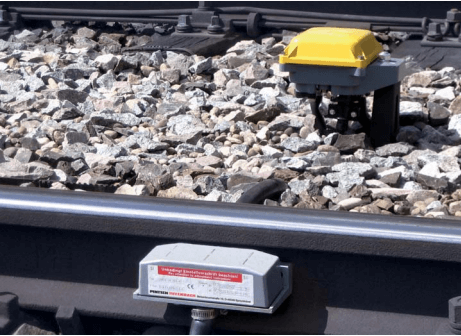
At the center of this innovation is the IWS series—electronic sensors designed to detect metal wheel flanges using electromagnetic fields. Installed on the rail web or between the rails, Pintsch Tiefenbach's railway inductive wheel sensors operate by creating a magnetic field that detects the disturbance caused by passing wheelsets. This non-intrusive, fail-safe detection method ensures that critical data is transmitted in real-time to signaling and control systems, allowing for highly accurate monitoring of train movements.
These sensors are a vital component of railroad axle counting systems, providing redundant data verification and position tracking in mainline and yard environments. Unlike traditional track circuits, which rely on the electrical conductivity between rails and are often vulnerable to environmental interference, Pintsch Tiefenbach's inductive sensors function reliably in all weather conditions—including snow, ice, and flooding. This robustness makes them particularly suited for North America's varied climate and demanding terrain.
One of the defining features of these sensors is their compliance with Safety Integrity Level (SIL) 4—the highest certification under international safety standards. Each unit is built to fail-safe principles and undergoes rigorous validation in accordance with EN 50126, EN 50128, and EN 50129 standards. This level of reliability is essential for mission-critical applications such as train detection at crossings, interlockings, and station approaches.
Beyond safety, these sensors offer scalability and ease of integration. Pintsch Tiefenbach’s IWS solutions are modular and can be incorporated into broader signaling networks, including centralized traffic control (CTC) and Positive Train Control (PTC) frameworks. They are compatible with standard signaling relays, data loggers, and electronic interlocking systems, simplifying both installation and maintenance.
Pintsch Tiefenbach’s sensors support a range of data outputs—from pulse-based detection for basic applications to smart sensor arrays capable of providing direction, speed, and train length. These capabilities are especially beneficial in high-density corridors, where real-time operational data is crucial for optimizing traffic flow and ensuring safety.
Recent developments have included the integration of intelligent diagnostics and remote monitoring features into the IWS product family. Using secure IP-based communication, railway operators can now track the health and performance of each sensor in real time. This remote functionality significantly reduces maintenance costs and response times, while enabling condition-based asset management strategies.
Field-tested across multiple rail segments in North America and globally, Pintsch Tiefenbach’s inductive sensors have proven their durability in harsh environments. Constructed with corrosion-resistant materials and sealed to IP68 standards, the sensors withstand mechanical stress, electromagnetic interference, and extreme temperature variations. They also feature tamper-resistant mounting mechanisms to prevent vandalism or unauthorized adjustments.
These technologies play a crucial role in enhancing the reliability and efficiency of urban transit systems, regional commuter lines, and transcontinental freight routes. They are frequently installed at level crossings, in multi-track junctions, and within automated yard operations, where precise wheel detection is necessary for coordinated train control.
Beyond the sensor hardware, Pintsch Tiefenbach North America provides complete support services including design consultation, system engineering, field installation, calibration, and lifecycle maintenance. Their engineering teams collaborate with transit agencies, freight carriers, and infrastructure contractors to customize sensor configurations based on site-specific requirements.
Moreover, the company’s IWS systems contribute to broader railway automation trends, enabling autonomous train detection and integration into AI-powered dispatch systems. As rail operators seek smarter, more predictive infrastructure, Pintsch Tiefenbach’s sensors form a key part of the digital transformation strategy within the industry.
This continued evolution is supported by a rich legacy. The company traces its roots back over 140 years to the invention of pioneering rail lighting systems in Germany. Its modern-day operations in North America reflect a blend of time-honored engineering excellence with a relentless push toward innovation.
As the rail sector contends with growing freight volumes, urbanization, and increasing safety expectations, Pintsch Tiefenbach North America’s inductive wheel sensor systems offer scalable, intelligent solutions that support safe, efficient, and sustainable rail networks.
Sources:
-
Pintsch Tiefenbach North America Official Website
-
Federal Railroad Administration
-
Association of American Railroads
-
American Railway Engineering and Maintenance-of-Way Association
-
IEEE Standards Association
-
Schaltbau Group Corporate Reports


 icons at the top right corner of the subsection.